QueerCraft Brings Tokyo’s Queer Card Game to the US
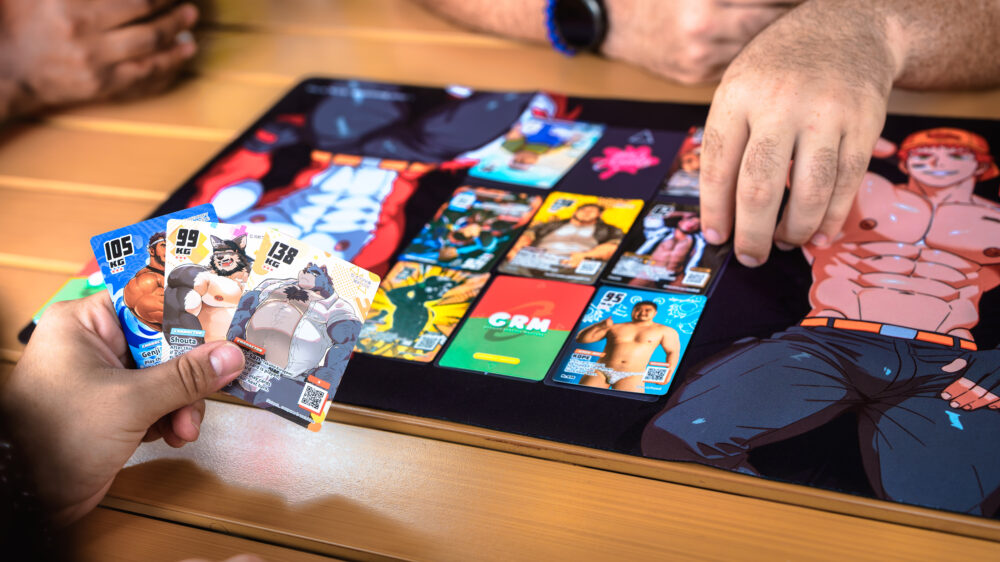
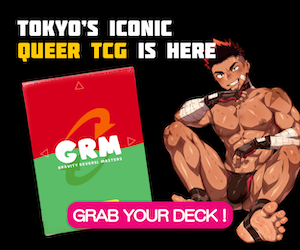
Until recently, there was a trading card game you could only really get in Shinjuku 2-chōme, Tokyo’s gay district. QueerCraft’s K-Pup picked up a set on a trip to Japan, got hooked, and then realized he was probably the only person in America who owned one. So he tracked down its creator, Nichoman!, and the studio has now released the first US edition of Gravity Reversi Masters (GRM).
Sold through 2-chōme’s queer manga market, GRM puts real go-go boys, drag queens, artists, bears and furries from Japan’s queer scene on its cards. Players lay cards on a board and weigh them against their opponent’s, flipping the ones they beat over to their side. Set the board up right and a single card can flip several at once. If you lost whole weekends to Triple Triad or Tetra Master, you’ll know the feeling.
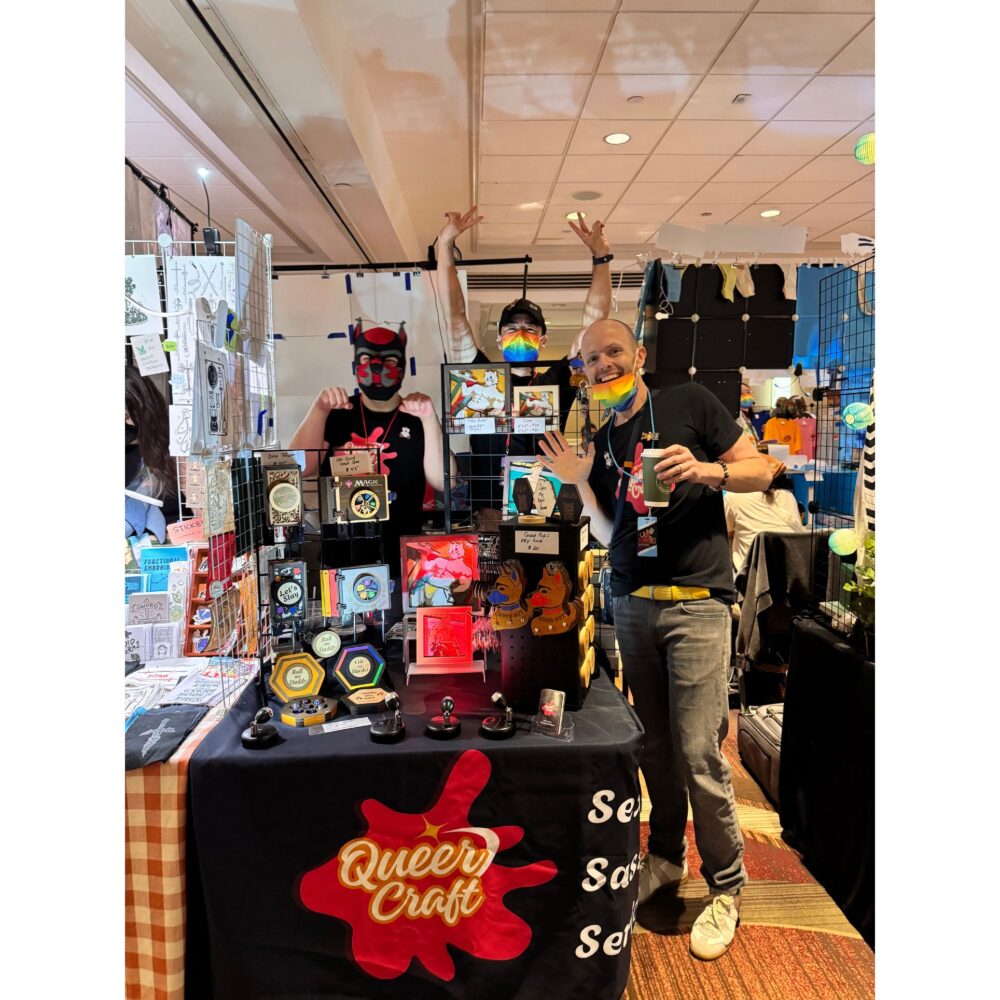
QueerCraft is a queer-owned studio in Hoboken, New Jersey, run by K-Pup, Ron and Zhao. They started out laser-cutting tabletop gear (deck tomes, dice towers, dice vaults, pup pins, bara shadow boxes and a bottle opener called “Bottoms Up”) after Ron got fed up with craft and collectibles markets full of “Live, Laugh, Love” signs. Their first convention was FlameCon 2025, where they sold out of a lot of their stock on day one, and Awesome Con and Jersey City Pride have featured them since.
GRM’s pre-sales were strong enough to speed up their plans. Booster packs adding pups, furries, leather and shibari are due between late 2026 and early 2027, they’re already imagining a US deck built around American artists, performers and kink community figures, and they’ve picked up a growing fan base in Mexico. K-Pup also hints there may be a K-Pup card on the way.
I talked to all three about GRM, plus Yu-Gi-Oh! awakenings, raccoon wizards and the convention staffer who had a problem with men in briefs.
Robin: Let’s start at the beginning. What was the first game that properly hooked each of you, and when did you realize your gaming life was a lot queerer than the box art let on?
Ron: I played a lot of board games with my family as a kid, but Everdell is what really got me hooked on exploring board games as an adult. It was also the first game we made stuff for with our laser: little resource boxes engraved with cute critters.
I think gaming got a lot queerer for all of us once we started noticing the game cafés that seemed to be popping up everywhere. A lot of them (most of them, actually) had LGBTQ+ game nights on the schedule, which we thought was really great. Once we started going to some of the cafés regularly, it really hit us how much overlap there is between tabletop gaming and the queer community.
Zhao: Gaming has always been a sanctuary for me. As an overweight, nerdy kid, it gave me a safe space to be whoever I wanted. The first game I was obsessed with was the Yu-Gi-Oh! trading card game, and I spent a lot of my allowance pulling cards. I was heavily influenced by the anime, and I was mesmerized by the excitement of the duels and the stories the cards brought out of each character. Growing up in China, there was no queer space for me in real life, but the game often mapped queer identities, metaphors and aesthetic subcultures onto specific card archetypes. Exosister, for example, plays on classic yuri and religious-sister tropes. And of course, some of the sexy male characters, like the Dark Magician, were my early gay sexual awakening.
K-Pup: I was four years old, playing Mortal Kombat on the PS1, and I remember loving Kitana… Let’s just say I love combat, but for some reason her elegant fan moves mesmerized me. One day, I want battle fans too… As for the queer side, Sora x Riku and Roxas x Axel from Kingdom Hearts started something when I was a kid… I mean, c’mon…
If you were each a playable character, what’s your class, your signature move and your fatal flaw?
K-Pup: Hoho!! I love this question… My human, pup and furry forms all revolve around me, so I’d say my class is a ranger type with a twist mechanic. I use a paradigm system (kudos to FFXIII), where my human form is a support/medic class, my pup form is a ravager/agile class and my furry form is a tank/berserker class. My signature move combines all three into one (honestly, it’s still TBD). My fatal flaw? I’m driven by a hyper-independent need to protect others, so I usually fight alone, hence the complicated system.
Zhao: A tiger furry paladin who wields a big, hefty magical ax. Signature move: busting out of my shiny armor and spinning my ax into a thunderous hurricane. I love a powerful, dramatic super move. Fatal flaw: hopeless romantic.
Ron: Wizard. A raccoon wizard, hands down. Signature move: probably teleporting away. My social battery drains pretty fast, so an instant getaway lets me recharge my magic and not have a meltdown. Fatal flaw: probably getting distracted by garbage cans.
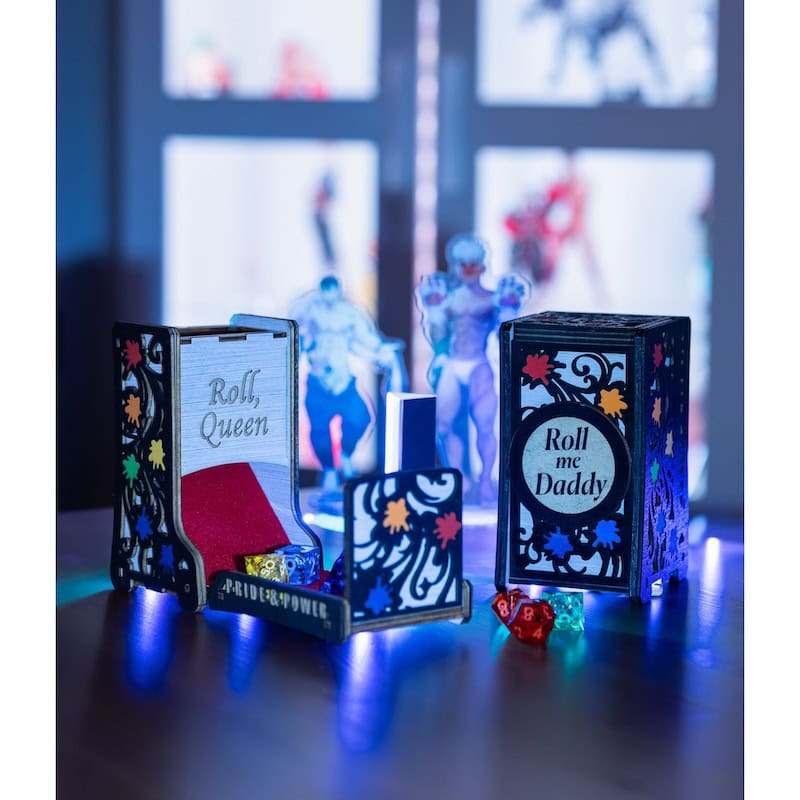
What was the moment you looked at a game table and thought, “this needs a dice tower with a gay agenda”? What was missing that you were sick of not seeing?
Ron: It actually happened a bit backwards, and a little bit out of disgust and frustration. I’d go to artisan markets and see all the really cool things people were doing with wood and laser cutting, but virtually every stand had the same “Live, Laugh, Love” bullshit and the same templates used over and over with zero imagination. It really frustrated me that people kept regurgitating the same overly wholesome nonsense.
At the same time, we were getting into gaming as a group, so it just clicked. We wanted to use our creativity and our laser cutter to make things that were edgier and more queer-forward, for actual adults who don’t have 32 kids. From there it went from designing artwork and engravings to “Let’s make some fun, queer, edgy items for when we’re playing games, and start a conversation.”
Zhao: For me, it’s deeply rooted in that overwhelming joy of finding out someone at the game table is queer. That double connection, gaming and queer, instantly sparks interesting conversations and bridges the social gap. Why can’t we do more of that, rather than leaving such an important connection to chance? I wanted an organic way to make that connection happen, and that IS my gay agenda. The idea struck when I noticed how a good graphic tee can break the ice and start a conversation. We needed the same concept, applied visually to gaming!
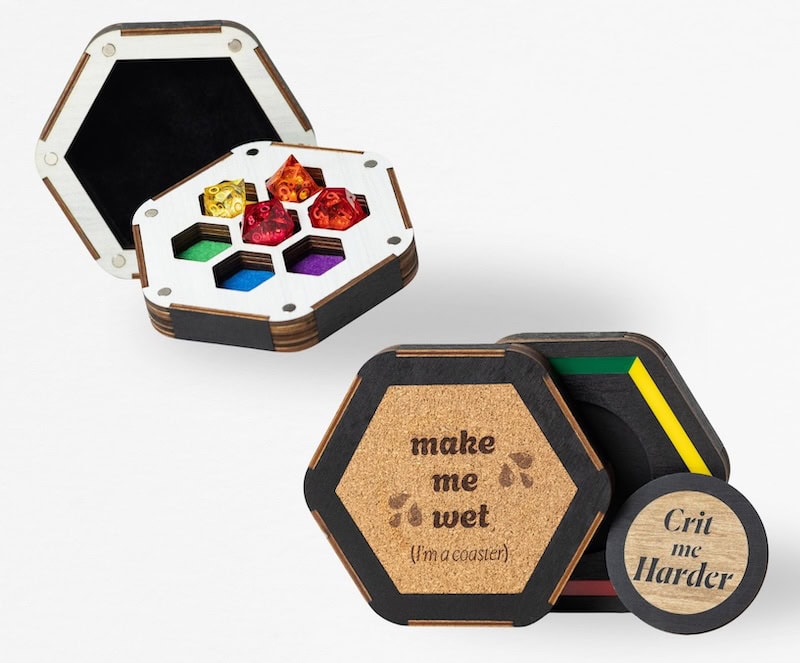
Bara art, kink pins and a bottle opener called “Bottoms Up” aren’t exactly what the big tabletop brands are selling. Has that caused you any trouble with conventions, and how do you stay unapologetic about it?
Ron: Yeah, I’m pretty proud that we’re pushing the NSFW boundary without going over it, for the most part. And to your point about it not being what the big tabletop brands are selling: that’s exactly why we’re doing what we’re doing. They’re either too scared, too biased or too unimaginative to create anything new and exciting.
K-Pup: I once went to a small anime convention on my own and had my bara shadow-box art on display. They’re all bara, so shirtless men in briefs and provocative poses. Sexy, but not nude or explicit.
One of the staff came over and questioned whether what we were displaying was suitable, which really frustrated me. I immediately said, “Well, if you think this isn’t appropriate for the venue, then I assume you’re going to go over and talk to that vendor with a woman riding a motorcycle with her boobs popping out, where you can almost see her vagina.”
As soon as I pointed that out, they said, “Oh, OK, good point,” and moved on. They were definitely caught up in it being queer, but at least they backed off once they realized the double standard.
Zhao: I handle most of our convention and event applications, and a good portion of the ones we apply for don’t accept us. It’s hard to say whether that’s because they’re highly competitive or because something’s going on behind the scenes when they look at what we sell. I think it’d be naive, in today’s political and social climate, to think it hasn’t been a factor in at least a few of those rejections. We’ve had really strong positive feedback from attendees, and convention staff have noticed us at some of these events, so I hope what we’re doing starts to become a bit more mainstream.
Was there a specific moment while running QueerCraft when you thought, “yeah, this is why we do it”?
Zhao: It was absolutely our first convention, FlameCon 2025. We had a tiny four-foot table with a handful of deck boxes, dice towers and the shadow boxes Tim made. That event could really have broken our spirit if it hadn’t gone well or if we’d been overlooked, but we sold out of a lot of products on our very first day. At one point our booth was surrounded by a group of pups, and they were all just so excited that we had pins, dice towers and deck boxes representing the pup community. Seeing how excited customers were and how much it meant to them, we really thought, “Holy shit, this is something we’ve got to grow.”
Ron: Not to get too sentimental or mushy, but the customer stories that make me happiest are when teens come to these events with their parents. We see parents completely embracing their kids’ involvement, not just in queer culture but in subcultures like pup play and drag. I never expected to see it, but it’s so surprising and amazing, especially with all the negative shit you see in the headlines.
I mean, a mother came to our booth with her son, a teenager who performs in drag and was there in an amazing drag outfit, and she was just gushing about what a great performer they are, how beautiful they are and how much talent they have. It was really great to see.
K-Pup: I remember the first time we debuted at FlameCon. At first I was scared and terrified. Then I remembered I’m actually really comfortable being “fun” in front of people, which is EXACTLY what I did. I was jumping around, saying hi to everyone and just being the happy pup I am! Somehow, by the next day, I’d drawn a HUGE pup crowd to the booth and we just started pupping out. Next thing, the drag queens came over, gave me gifts and said, “We were told there was a cute pup here and we really wanted to meet him!” Yeah… I do this because I want to bring smiles and energy to people.
How did a studio in New Jersey end up bringing a trading card game from a queer manga market in Shinjuku 2-chōme to the US for the first time?
K-Pup: I visit Japan quite often because I have a lot of friends who live there. Last year, I saw a bunch of queer card games and bought almost all of them to check them out. GRM really stood out to me, and I got hooked on collecting the Japanese cards. But it got lonely: I was probably the only American with GRM cards, and I had no one to play with. That’s when I knew I wanted to bring the game to America. Not just to introduce Americans to the performers and artists, but to expand the game with American queer culture, and other countries’ queer culture in the future. That’s a goal Nichoman! (GRM’s creator) and I share. After that, it was just a matter of working my network. My dear friend Coffee found me Nichoman’s contact, and once I introduced myself, everything started falling into place!
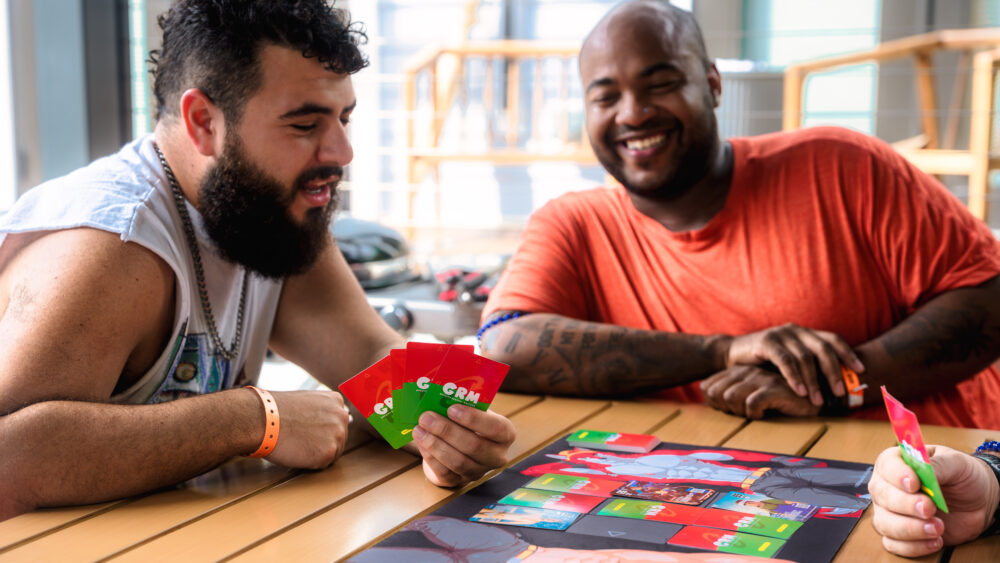
GRM celebrates real go-go boys, drag queens, artists, bears and furries from Japan’s queer scene. What did you need to get right culturally when bringing it across the Pacific, and what surprised you about the differences, or similarities, between queer culture there and here?
K-Pup: Some of the art would definitely be frowned upon in America. When I was curating the first deck, I wanted a collection that was socially acceptable while still testing the limits, because some of the characters in the original roster seemed a bit… young. In Japan, that’s socially acceptable as long as they say all the characters are 18+, but I don’t believe that would fly in America, even with censorship.
When I showcased the first 12 cards at an event, I was surprised by how many people knew the artists. Some even knew the go-go boys and drag queens! And one big similarity between here and Japan is that Nichoman and I aim to bring body diversity to our audience. Not every card is going to be slim, athletic or muscular. We want as many body types as possible to be celebrated, and Americans love that too.
GRM has been compared to Triple Triad and Tetra Master. For players who lost entire weekends to those, what makes the weigh-and-flip mechanic so satisfying?
K-Pup: If you manipulate the board correctly, flipping multiple cards with just one card is extremely satisfying. Plus, let’s be honest, getting a drag queen to flip a big boy is quite the sight!
Who’s the reigning GRM champion at QueerCraft HQ?
K-Pup: Me. ‘Nuff said… If Ron or Zhao beat me from time to time, it’s because I’m testing a new deck structure or going easy on them. I sometimes play Nichoman! virtually during our meetings, and I’ve beaten him too!
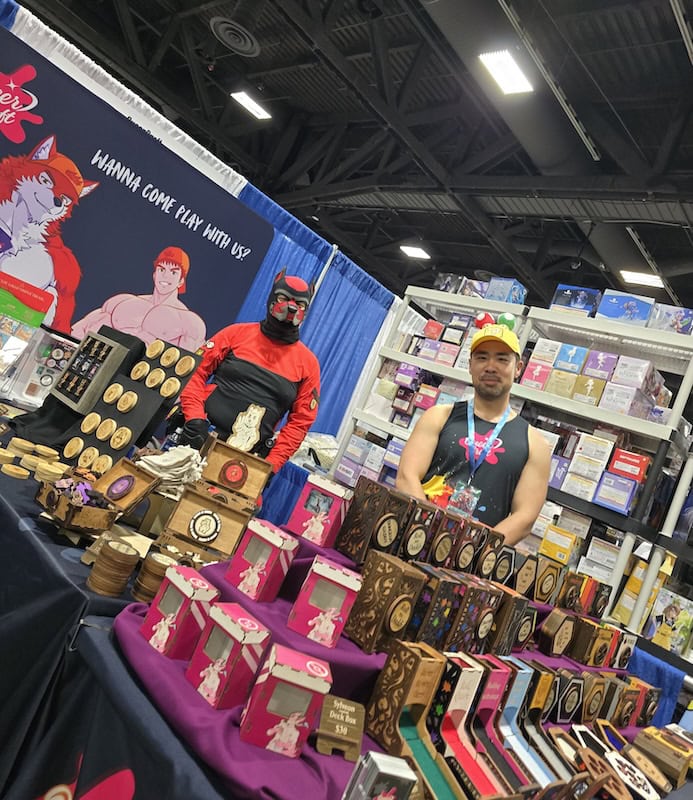
Booster packs are on the way for late 2026 into early 2027. What can players expect, and what’s the bigger dream for GRM and QueerCraft?
Ron: With the booster packs, we’re really looking to bring in other elements of queer subculture and kink: pups, furries, leather, shibari rope play, things like that.
The bigger dream for GRM has really been accelerated by how incredibly strong our pre-sales were. We’re definitely trying to envision what a US GRM deck would look like. Sourcing artists, performers and prominent members of kink communities across the country would be incredibly exciting.
We’ve also been surprised by how much attention and how much of a fan base we’re getting from Mexico. There seems to be a really vibrant pup and furry community there, a vibrant queer community in a lot of the cities overall, and some incredible artists doing great character and bara work.
Long term, making GRM not just a collectible card game but a cornerstone of queer culture in multiple countries would be such a humbling thing to achieve. It would do so much to bring queer culture to the forefront and normalize sexuality and kink as part of being human, not just part of being queer.
K-Pup: More furries, more bara characters that Americans will IMMEDIATELY recognize, more go-go boys and more drag queens with their new friends, the PUPS! Hint, hint: there might be a K-Pup card coming soon. One of my bigger dreams for GRM and QueerCraft is to create a collection that represents American queer culture. That means more pups, BDSM masters, performers, icons, stars, art by American queer artists, and more! Maybe in the American collection I can introduce a new attribute that Japan doesn’t have.
Finally, what does it mean to you to put queer culture, quite literally, in players’ hands?
Zhao: As a first-generation US citizen who came from China in my early twenties, I have strong firsthand experience of what it’s like to be a bit marginalized and underrepresented in society. For me, taking part in elevating queer visibility in any way is really important. But what’s even more exciting is that we’re taking kink subculture out of the shadows, out of the corners and edges of society, and putting it front and center at major conventions and events, hopefully across the US as we grow. These communities are diverse and vibrant. They’re full of personality and creativity, and I don’t understand why, in today’s society, they’re still shied away from when it comes to representation on any commercial level. Helping give them equal footing when it comes to expression, at the game table or beyond, is really what we’re here for.
Ron: Yeah, on that note about the game table: so much of tabletop gaming, especially RPGs, is about expression, right? It’s about bringing who you are as a person into your character. And when you look at how much crossover there is between tabletop gaming, RPGs and the queer community, it’s a really shitty situation that there’s no other company out there (or at least no mainstream company) bothering to give queer players a way to do that. That seems like a very intentional choice. If we can fill that gap and do whatever we can to give queer players the opportunity the cis, hetero community has had since, well, games were invented, then that’s what we’re here for.
K-Pup: More queer power to the players! Honestly, having gear and cards that look this good is amazing, especially when it’s created for the queers, by the queers, and it’s queer.
Learn more about GRM and purchase your copy now on the QueerCraft website
About The Author